Thursday, December 17, 2015

Tuesday, December 15, 2015
The Mother of All Demos
"The Mother of All Demos" is a name given retrospectively to Douglas Engelbart's December 9, 1968, computer demonstration at the Fall Joint Computer Conference in San Francisco. The live demonstration featured the introduction of a complete computer hardware and software system called the oN-Line System or more commonly, NLS. The 90-minute presentation essentially demonstrated almost all the fundamental elements of modern personal computing: windows, hypertext, graphics, efficient navigation and command input, video conferencing, the computer mouse, word processing, dynamic file linking, revision control, and a collaborative real-time editor (collaborative work). Engelbart's presentation was the first to publicly demonstrate all these elements in a single system. The demonstration was highly influential and spawned similar projects at Xerox PARC in the early 1970s. The underlying technologies influenced both the Apple Macintosh and Microsoft Windows graphical user interface operating systems in the 1980s and 1990s.At http://en.wikipedia.org/wiki/The_Mother_of_All_Demos.
Saturday, December 12, 2015
The Ultimate Guide To Cloning In Photoshop

"Photoshop’s wide array of cloning tools is the cause of many of the absolute best and worst works created with the application. In a skilled and experienced hand, these tools lead to phenomenal results. In the hands of a careless artist, Photoshop cloning can be disastrous to the credibility of the result. This article introduces the several cloning tools available in Photoshop and goes over the proper usage and best practices of each."
At http://www.smashingmagazine.com/2010/03/30/the-ultimate-guide-to-cloning-in-photoshop/.
Monday, December 7, 2015
Aula Aberta Christian Faubel: Robots, disco & cinematography

Aula Aberta Christian Faubel: Robots, disco & cinematography
Quinta-feira, 10 de Dezembro às 17:00
https://www.facebook.com/events/1530007133984419/
Christian Faubel will present an overview of his work, including robotic installations, participatory workshops and live performances. Central to his work is the use of robots as philosophical toys that convey scientific insight,while providing amusement and entertainment.
Christian Faubel is an interdisciplinary researcher and artist. He is currently working at the laboratory for experimental computer science within the Academy of Media Arts Cologne. He holds a PhD in electrical engineering and has completed research on autonomous systems at the Institute for Neural Computation from 2002–2012.In 2002 he founded derstrudela collective for the mediation of a relaxed approach to electronics robotics. Since 2002 he has taught more than 50 workshops in building simple analog robots at international venues and festivals. Together with the artists Tina Tonagel and Ralf Schreiber he is also part of the overhead projector band Ray Vibration.
They use overhead projectors, self build-instrumentsand analog robots for creating audiovisual performances. In his work he is interested in what enables autonomous behavior and how complex autonomous behavior may result from the interaction of very simple units and from the dynamics of interaction between such units. In his artworks and performances he tries to convey insights about theoretical concepts such as emergence or embodiment along an aesthetic dimension. He considers his artworks, workshops and performancesto be in the tradition of philosophical toys as they combine the mediation of scientific concepts with pleasure and amusement.
Sunday, December 6, 2015
Scribus
Scribus is an Open Source program that brings professional page layout to Linux, BSD UNIX, Solaris, OpenIndiana, GNU/Hurd, Mac OS X, OS/2 Warp 4, eComStation, Windows and Haiku desktops with a combination of press-ready output and new approaches to page design.
Underneath a modern and user-friendly interface, Scribus supports professional publishing features, such as color separations, CMYK and spot colors, ICC color management, and versatile PDF creation.
At http://www.scribus.net/ and http://www.scribus.net/canvas/Scribus.
Scribus Help Manual at http://wiki.scribus.net/canvas/Help:TOC.
Viúvas e orfãos
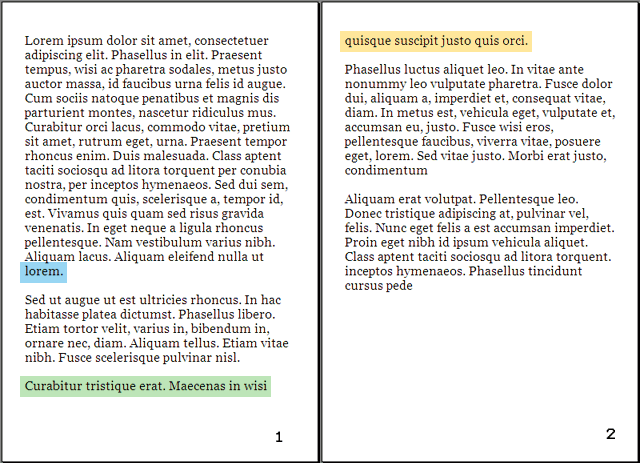
"In typesetting, widows and orphans are words or short lines at the beginning or end of a paragraph, which are left dangling at the top or bottom of a column, separated from the rest of the paragraph. There is some disagreement about the definitions of widow and orphan; what one source calls a widow another calls an orphan. The Chicago Manual of Style uses these definitions:
Widow
A paragraph-ending line that falls at the beginning of the following page/column, thus separated from the rest of the text.
Orphan
A paragraph-opening line that appears by itself at the bottom of a page/column.
A word, part of a word, or very short line that appears by itself at the end of a paragraph. Orphans result in too much white space between paragraphs or at the bottom of a page."
At http://en.wikipedia.org/wiki/Widows_and_orphans.
Subscribe to:
Comments (Atom)